
The 9 Markets VCs Are Actually Funding in 2026

3x founder · Coach to 300+ founders
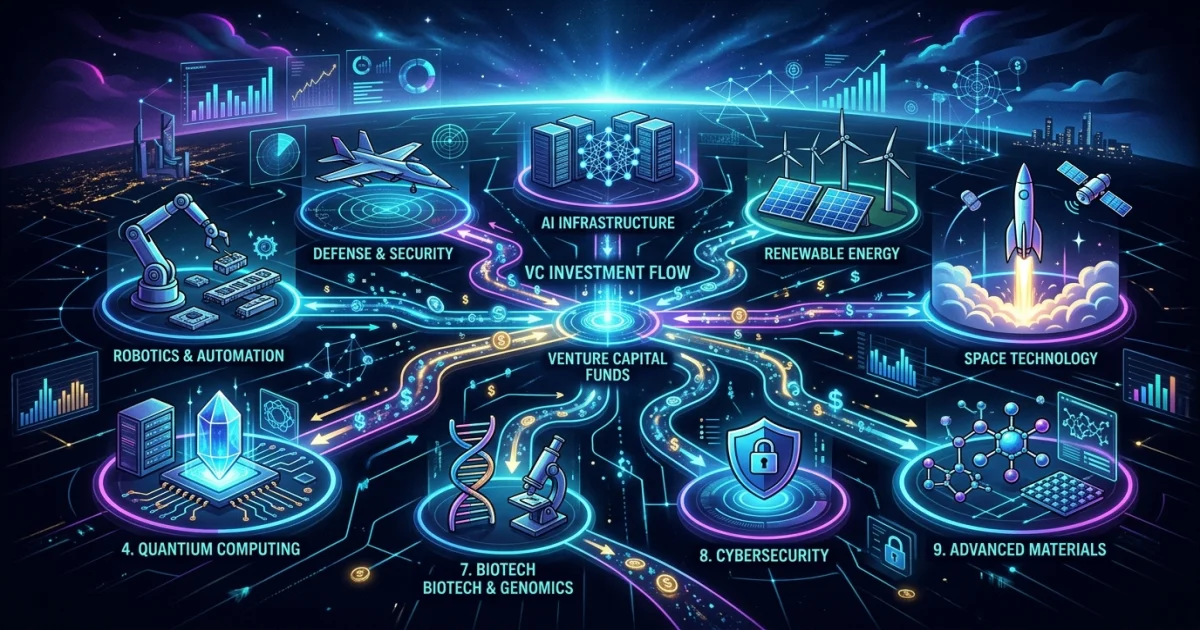
In the first half of 2026, US venture invested $412.7 billion. AI companies took $355.9 billion of it. That is 86 cents on the dollar.
Roughly nine in ten of those dollars went to rounds of $100 million or more.
Founders read that number and conclude AI is fundable. That read costs them a year. Capital is loud at the top and quiet in the middle. The money did not go to “AI.” It went to nine specific markets, and four of them are gated on access you cannot buy in a quarter.
The markets VCs are funding in 2026
| Market | Fundability now | What the fundable startup looks like | What investors will want to see | Founder bar and recent evidence |
|---|---|---|---|---|
| Vertical AI systems of action | Very high | Runs a central, expensive workflow rather than assisting around its edges. It dispatches, underwrites, reconciles, schedules, sells, files, procures or resolves cases. Ideally it can charge against labor, revenue or EBITDA rather than the existing software budget. | A live workflow, several serious design partners, and evidence that the product completes work rather than merely generating suggestions. A credible expansion from one wedge into the operating layer for the industry. | Strong domain access matters more than generic AI credentials. a16z’s Probook investment centered on owning the dispatch decision in home services. Hilbert begins with data plumbing and expands into growth execution. Bessemer and General Catalyst are explicitly pursuing software that absorbs service and labor budgets. |
| AI infrastructure bottlenecks | Very high, elite-gated | Removes a bottleneck in inference, memory, agent orchestration, evaluation, reliability, multimodal data or networking. It must solve something that becomes more painful as model usage scales. | Real benchmarks, meaningful open-source adoption, usage by sophisticated technical teams, or credible hyperscaler and frontier-lab relationships. A generic “developer platform for agents” will not cut it. | The technical bar is as high as it gets. Inferact was built around the maintainers of vLLM. Protege was founded by repeat data-infrastructure entrepreneurs and focused on hard-to-access real-world training data. Bessemer argues value is moving from model training toward inference, continual learning, memory and reliability. |
| Defense autonomy and sovereign technology | Very high, access-gated | Replaces an existing military capability with something cheaper, faster, more autonomous or more resilient. Strong areas include command and control, electronic warfare, communications, navigation, autonomous systems and industrial capacity. | Operational demonstrations, a credible procurement pathway, manufacturability, and performance under adverse conditions. A defense-themed pitch deck without operator validation is worthless. | The ideal team combines military operators, technical depth and procurement knowledge. NODA’s founders had direct joint-fires and defense-software experience before raising a $25 million Series A. General Catalyst backed Constelli after years of electronic-warfare development and operator use. |
| AI data-center power, networking and cooling | Very high, capital- and relationship-gated | Shortens time to energization, raises GPU utilization, improves networking throughput, manages distributed energy, or solves cooling and grid-interconnection constraints. The value should be measured in megawatts, deployment months or compute output. | Utility, hyperscaler or data-center partnerships. Technically credible hardware or infrastructure. Contracts or deployments, and a believable path through long enterprise sales cycles. | A difficult sector for outsiders. Bessemer identifies generation, grid equipment, energy orchestration, networking and cooling as the major constraints, and led both Verse’s $54 million Series B and DriveNets’ $410 million Series D. Lightspeed and a16z put $500 million into Nexthop at a $4.2 billion valuation. |
| Agentic cybersecurity | High | Provides identity, permissions, runtime policy, monitoring or autonomous remediation for fleets of AI agents. The stronger companies take corrective action rather than producing another dashboard full of alerts. | Deep enterprise integrations, low false-positive rates, reduced remediation time, and control over what agents can access or execute. Security credibility is mandatory. | Bessemer calls agent security a defining cybersecurity problem for 2026, while a16z is backing infrastructure for controlling enterprise agents. Bessemer also led QIZ’s $17 million seed around post-quantum cryptographic posture and remediation. |
| Physical AI and industrial robotics | High, brutally elite-gated | A vertically integrated system that performs a valuable task in a messy real-world environment. The winning company usually owns the model, hardware, deployment process and data flywheel rather than selling a general-purpose robotics model. | Real deployments, reliability data, improving unit economics, and a privileged source of training data. A polished lab demo is not enough. | Requires rare hardware, ML and operational talent plus substantial capital. Bessemer expects near-term value to accrue primarily to full-stack companies. Mind Robotics’ Rivian deployment gives it a live manufacturing data environment. Waymo’s scale shows how operational and regulatory advantages compound. |
| Healthcare operations and data infrastructure | High | Automates medication access, reimbursement, care navigation, clinical administration or fragmented data exchange. The best wedge sits where delays and administrative labor produce measurable financial or clinical harm. | EHR, payer, provider or pharmaceutical integrations. Reimbursement clarity, compliance, and measurable improvements in turnaround time, workload or access. | Founder-market fit and industry relationships are unusually important. Thrive Capital led Forus’s $160 million Series B, with General Catalyst participating, on medication access across a fragmented payer, provider and pharma system. Baba combines AI with human advocates and Medicare reimbursement. Protege targets proprietary, regulated healthcare and enterprise data. |
| Stablecoin and AI-native financial infrastructure | High, selective | Becomes a system of record or a transaction rail for cross-border payments, treasury, compliance, banking infrastructure or machine-to-machine commerce. It should remove structural friction rather than adding crypto to an existing product. | A regulatory pathway, banking partners, transaction activity, distribution, and evidence that stablecoins materially improve settlement cost or speed. | Deep financial and regulatory expertise is essential. Bessemer argues stablecoins have crossed into infrastructure, while a16z sees stablecoins plus AI automating global financial operations. Stitch was funded around a core banking API and strong regional regulatory relationships. |
| Consumer AI | Selective, traction-heavy | Creates a genuinely new habitual behavior, identity, relationship or entertainment experience. It needs organic distribution, retention or network effects rather than better generated content. | Exceptional cohort retention, frequency, virality or monetization. Consumer founders cannot substitute a compelling market narrative for actual user behavior. | Consumer and enterprise fundability are different games. AI lowered the cost of building consumer products. That makes differentiation and defensibility harder, so investors price the round off behavior. |
Ratings researched July 2026 from PitchBook data and published theses at Sequoia, a16z, Bessemer and General Catalyst.
Read the second column before the third. Four of these nine gate on something a founder cannot acquire between now and the next raise. Frontier-lab standing. Military operator relationships. A signed utility contract. Robotics hardware shipped at production volume. If you do not have it, the market being hot works against you, because you are competing for attention with teams that do.
That is the part the “pick a hot sector” advice skips. A hot market with a high founder bar is the worst place for an ordinary team. The capital is there and none of it is for you.
What a fundable company looks like across all those markets
The market decides whether you get the meeting. Ten dimensions decide whether you get the round. They are the same ten in every lane on that list.
| Dimension | Fundable version | Weak version |
|---|---|---|
| Market narrative | ”This transition is inevitable, and this bottleneck must be solved." | "The market is large and AI is growing.” |
| Product position | Owns the central decision, transaction or execution workflow. | A copilot, dashboard or peripheral feature. |
| Economic value | Replaces labor, raises revenue, frees capacity or controls serious risk. | Saves employees a few minutes. |
| Wedge | Narrow, painful and immediately valuable. | Broad platform before proving one job. |
| Expansion | Wedge → system of action → system of record or network. | Remains a narrow point solution. |
| Moat | Proprietary data loop, network effects, workflow depth, regulation, distribution, hardware or switching costs. | Prompt engineering and public data. |
| Founder credibility | The team has lived the problem, built the underlying technology, or already knows the buyers. | Smart generalists discovering the industry through customer interviews. |
| Pre-seed proof | Working deployment, serious design partner, open-source adoption, procurement interest, or an unusually strong technical result. | Waitlist registrations and nonbinding letters of intent. |
| Pitch legibility | One sentence that makes the company’s importance obvious. | Seven categories and twelve buzzwords. |
| Timing | A recent technological, regulatory or economic change makes the company newly possible or necessary. | A long-standing problem with no convincing reason it gets solved now. |
Now read down the weak column. That is most decks I see. A copilot, a waitlist, prompts as the moat, and a market-is-huge slide. Every one of those is a choice the founder made, and every one of them is reversible in a quarter. The gated markets are not.
Every “narrative only” round had hidden proof
The dangerous version of fundraising advice is: pick a hot sector, tell a clean story, raise before you build.
I have watched that fail up close. Every recent round that looks like narrative alone turns out to contain proof somebody skipped over. A founder who built the adjacent company. A maintainer of a critical open-source project. Direct access to military operators, utilities or hyperscalers. Years inside the exact workflow.
That is not “no traction.” It is non-revenue traction, expressed as credibility, access and technical de-risking. Investors count it. Founders do not, because it does not show up in a metrics slide.
I was fractional COO at Humoniq when it raised $8.5 million with no production code. The narrative was clean. It also had a team that had lived the problem and a YC batch behind it. Contrast that with Hamza at Traversaal, who had $500K in revenue and TripAdvisor as a customer and still could not raise, because he pitched search latency instead of the future of enterprise work. More on that trade in fundability vs investibility.
The 10 questions I research instead of chasing hot sectors
Tracking “hot sectors” tells you where the money went last quarter. These tell you where it is going and whether you are allowed in.
- What expensive human work are VCs newly willing to classify as software revenue?
- Which bottlenecks are preventing AI adoption inside large enterprises?
- Which startup can own the central system of action rather than remain a feature?
- Where are regulation, procurement or physical complexity becoming moats instead of liabilities?
- What proof substitutes for revenue at pre-seed: founder pedigree, open-source adoption, design partners, contracts or working deployments?
- Which sectors have abundant capital but such a high founder bar that ordinary founders should stay away?
- Which investment theses are appearing independently at Sequoia, a16z, Bessemer and General Catalyst?
- What are investors actually funding that contradicts what they say publicly?
- Where does the initial wedge naturally expand into a system of record, execution platform or transaction network?
- Which currently popular narratives are already becoming commodity wrappers?
Question 8 is the one that pays. Firms publish a thesis and then write checks somewhere adjacent to it. Read the deal list. Skip the essay.
Where this breaks
This table is a snapshot of a market, so treat it like one.
Ratings move. A lane that reads “extremely high” in July 2026 can be a commodity wrapper by next summer, which is exactly what question 10 is for.
The nine markets describe venture fundability. They say nothing about business quality. Plenty of excellent companies sit in “none of these” and should never raise venture money at all. Bootstrapping a profitable agency beats losing four years chasing a lane you cannot win.
And if you are raising a Series A, none of this substitutes for revenue and retention. Narrative buys you the pre-seed and seed. It does not buy you the A.
Score yourself against it
Reading a table is not the same as knowing where you sit on it. The fundability calculator scores your market and your evidence separately, applies the founder-bar gate for your lane, and names the three dimensions holding your round back. Four minutes.
If you want to fix the pitch and book meetings in the next 30 days, book a strategy call.
Most founders pick the hottest lane and then discover they were never eligible for it. Check the gate first, then the story.
Related Startup Guides
All articlesGrow
Fundability vs Investibility: VCs Fund Stories, Not Products
Most founders spend months building the perfect product before pitching VCs. That is wrong. Learn why narrative legibility beats product-market fit.
Grow
Startup Pitch Deck: 10 Slides Investors Read
What investors actually look at in a startup pitch deck: the 10 slides that matter, what kills each one, and a copy-paste framework you can run today.
Scale
How to Write a Startup Business Plan That Investors Will Actually Read
Investors don't read 40-page business plans. They read the 1-page version that proves the hard trade-offs. The structure that earns the second meeting.

Farzad Khosravi
No BS Startup Coach · 300+ Founders Coached
I help early-stage founders launch, grow, and lead with clarity. I cut through the noise to the few tactics that actually change your numbers. I've coached 300+ founders across validation, growth, leadership, and fundraising.