
Product Market Fit Validation: Stop Building Blind

3x founder · Coach to 300+ founders
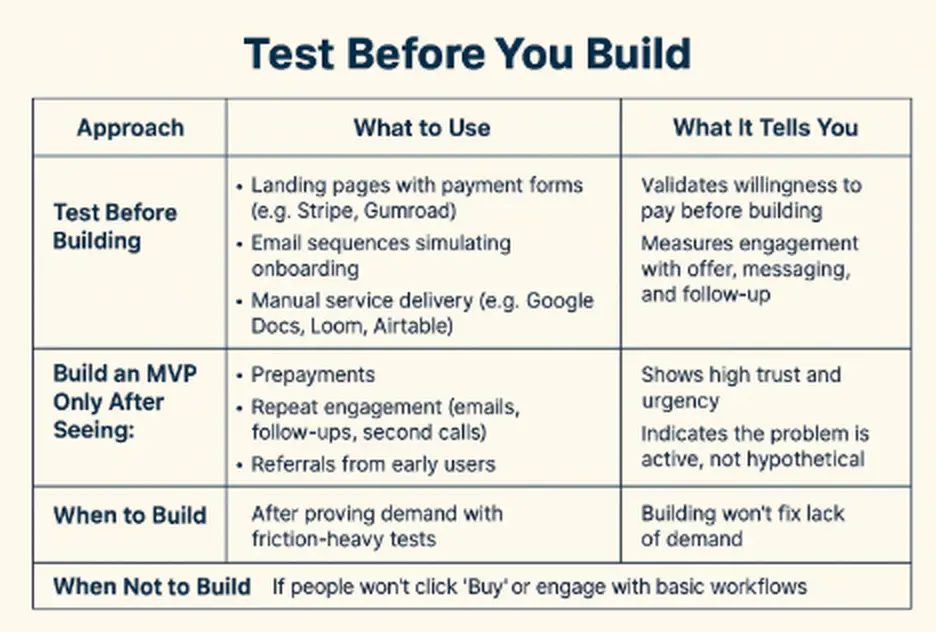
Product market fit validation is proving with evidence that people will pay for your product before you build it. The core signal is commitment: someone trades money, time, or access to get what you’re offering.
You had the idea. You pitched it to your friends, your coworker’s cousin, and that one guy from your last founder dinner. Everyone nodded. Some even said, “That’s brilliant.” You tossed up a waitlist page, got a few dozen signups, maybe even a hundred. The dopamine hit. You assumed you had demand.
Now you’re six weeks into building a product nobody opens. Signups stall. Feedback turns vague. The enthusiasm’s gone. What happened?
Early traction lies. People like ideas way more than they’ll pay for them. Product market fit validation is how you catch that before it costs you a dead launch and weeks of work you can’t take back.
That’s why product market fit validation needs more than positive feedback. It needs evidence. The polite enthusiasm everyone hands you does not count. Actual proof that someone has a problem, and is willing to act on it.
Validation also assumes the idea is worth testing. If the hypothesis came from copying competitor features instead of first principles thinking, the cleanest validation work in the world only confirms the wrong premise.
| Validation Signal | Intent Level | Cost to User | Signal Reliability |
|---|---|---|---|
| Social Likes & Verbal Praise | Low | $0 | ❌ Politeness (Zero Value) |
| Waitlist Email Signup | Low-Moderate | 5 Seconds | ⚠️ Passive Interest |
| Booked Discovery Meeting | Moderate | 30 Minutes | ⚠️ Problem Realization |
| Prepayment / Paid Deposit | High | Real Capital | ✅ High Signal (Validation) |
| Letter of Intent (LOI) | High | Executive Time | ✅ High Signal (B2B Demand) |
| Sean Ellis 40%+ Survey | High | Active Product Use | ✅ High Signal (PMF Achieved) |
How do you know when you actually have product market fit?
Most founders can’t answer this, which is why they keep guessing. Two definitions are worth knowing, and they point at the same thing.
The instinct version comes from Marc Andreessen, who popularized the term: “When you have product-market fit, the market pulls the product out of your hands.” You stop chasing customers and they start chasing you. Usage climbs on its own. Support and servers strain to keep up. If you’re still working hard to convince people to try it, you’re not there yet.
The measurable version comes from Sean Ellis, who ran growth at Dropbox and LogMeIn before most people had a word for it. Survey your active users with one question: how would you feel if you could no longer use this product? The answers sort into three buckets: not disappointed, somewhat disappointed, and the people who would be genuinely disappointed to lose it. If at least 40% land in that last bucket, you most likely have product market fit. Below that line you don’t, and more marketing won’t move the number.
The 40% mark isn’t magic. It’s the threshold Ellis found that separated the startups that took off from the ones that stalled. The value is that it’s measurable on real users, instead of a feeling you talk yourself into on a good week.
Before you even run the survey, rank what your interested users have already done, from weakest to strongest: a like, an email signup, a survey reply, a booked meeting, sharing their data, a prepayment, a renewal. Likes and emails cost them nothing, so they prove nothing. If they won’t put twenty dollars on the table, you don’t have product market fit. You have an audience that’s being polite.
Real Signals: What Actually Validates Product Market Fit
You don’t need more people saying they like the idea. You need people showing up with something to lose. Real validation happens when someone is willing to trade money, time, or access in exchange for what you’re building. That’s when interest turns into commitment. Commitment looks like money on the table or time on the calendar. A nod does not count.
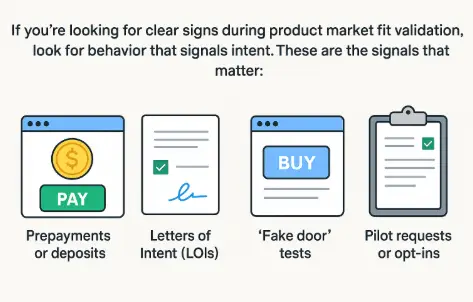
If you’re looking for clear signs during product market fit validation, look for behavior that signals intent. Not passive engagement. Not theoretical interest. Action.
These are the signals that matter:
- Prepayments or deposits: Nothing filters for urgency faster than asking someone to pay. Even a small fee changes the dynamic. It tells you they believe the problem is worth solving, now.
- Letters of Intent (LOIs): If you’re working B2B, an LOI is a clear step forward. It may not be binding, but it’s formal enough to show internal alignment on their side.
- “Fake door” tests: Create a landing page with a clear offer. Include a buy button, a signup field, or a calendar link. Then track who clicks. This kind of startup MVP testing reveals what people intend to do, not just what they say they’d do.
- Pilot requests or opt-ins that require effort: If someone fills out a detailed form, commits to a use case, or provides internal data, that’s worth far more than a one-click subscription.
Don’t try to make people say yes. Give them a real chance to walk away and watch who stays.
Turn conversations into commitments
The bridge between interviews and commitment is friction. The moment you add it through pricing, timelines, or effort, intent becomes visible. That’s when you start separating polite interest from real demand.
Here’s how to move beyond early discovery calls and into high-signal validation:
- Reframe your interview questions: Stop asking, “Would you use this?” Start asking, “When was the last time you tried to solve this?” or “What have you paid for to fix this in the past?”
- Add a next step at the end of every call: If the problem feels urgent, ask for a deposit or suggest a pilot. If they hesitate, ask what’s missing.
- Use landing pages as filters: Build pages that reflect your offer, pricing, and timeline. Drive traffic through targeted outreach or ads. Then track conversion, drop-off, and scroll depth.
- Layer in a basic offer: Before you write a line of code, offer the outcome manually, consulting, workshops, spreadsheets, or mockups. If no one buys the manual version, the automated one won’t fix that.
This is where startup MVP testing earns its place. You get to test whether anyone will pay your price before you write a line of code. If someone won’t pay for a stripped-down version, a polished UI won’t convince them.
Your goal during product market fit validation isn’t to convince people the product is good, it’s to find people already trying to solve the problem and willing to do something about it. The earlier you can force that decision, the clearer your path becomes.

When to Build an MVP (and When Not To)
Early-stage founders often treat the MVP like a starting point, but in most cases, it’s a detour. If you’re building before you’ve seen commitment, you’re guessing. That guess becomes a product roadmap, which becomes a backlog, which becomes technical debt tied to a problem no one’s paying to solve.
The purpose of an MVP is not to validate demand. The purpose is to ship a version of something people have already shown they want.
Until then, use startup MVP testing tools that don’t require engineering. You can learn what you need without writing a single line of code. That’s not a shortcut, it’s the work.
Here’s what that looks like:
- Landing pages with payment forms (Stripe, Gumroad, Lemon Squeezy): If they won’t click “Buy,” you don’t need to build the product.
- Email sequences that simulate onboarding: Test the messaging, the offer, and the follow-up. If people don’t engage now, they won’t engage later.
- Manual fulfillment: Build your service as a workflow before you invest in automating it. Not scalable? Perfect. You’re validating, not scaling.
Only after you’ve seen strong signals, prepayments, repeat engagement, referrals, should you consider a scoped-down version of the product. That version is built to serve existing behavior, not to create it from scratch.
If you’re at that point, the MVP build playbook covers the five paths (DIY, agency, in-house devs, venture studios, build-for-equity) with the constraints that make each one the right call.
During product market fit validation, the MVP doesn’t come first. Proof comes first. The MVP exists to support something that’s already working in a rough, manual form. If there’s no traction without the product, the product won’t save you.
A $100K lesson in skipping validation
A founder I worked with, Josh, learned this the expensive way. He built a deep, complex analytics dashboard for CFOs because he assumed they wanted power and depth. He spent around $100K building it before he checked that assumption against reality. When he finally read the complaints on competitor forums, they all pointed at one thing: too much complexity. His “more powerful” bet was the exact thing the market was backing away from. He stripped the product down to something simpler, adoption picked up, and he started landing paying customers within months.
The product was never the problem. The unchecked assumption underneath it was. This is the spirit of Rob Fitzpatrick’s The Mom Test: weigh what people have already done about a problem over what they tell you they would do.
The Anti-Vanity Checklist
It’s easy to mistake activity for traction. Waitlist signups, retweets, and kind words feel like movement, but they rarely convert into customers. That’s why you need a filter, a way to separate noise from actual signals.
Use this list to check your current validation strategy. If you’re not seeing at least one of these responses, you’re not done testing.
You’re getting close to product market fit validation when:
- Someone prepays, even if it’s a small amount
- A company offers to sign a Letter of Intent
- Prospects ask, “When can I get access?”
- They refer someone else without being prompted
- They follow up with questions, use cases, or budget
- They’re willing to test something manual or unfinished
Now compare that to this list. These are vanity signals. They feel good, but they don’t count.
These are not validation:
- “That’s such a cool idea.”
- “Let me know when you launch.”
- Unsolicited praise from people who don’t match your ICP
- 100+ waitlist signups with zero conversions
- Likes and retweets
There’s no need to waste months building for an audience that never committed in the first place. Your time, money, and energy are finite. Use them on people who are willing to move.
The Cost of Ignoring This
When you skip product market fit validation, you don’t get to skip the consequences. You delay them. Low engagement. Slow sales. Pivot after pivot. Those are not bad luck. They are what an unvalidated product looks like.
And if you’re somewhere in the middle, some interest, some feedback, but no hard proof, this is the exact gap my customer validation work closes. A real test settles it in a week, instead of leaving you to guess for six more months. We turn polite calls into people who actually pay. If that’s where you are, let’s fix it now instead of six months from now.
If you’re figuring out how to run those tests, or what to build next based on real demand, I share step-by-step frameworks at nobsstartupcoach.com, built from coaching 300+ founders through this exact stage.
Product market fit validation isn’t a checkbox. It’s how you stop building in the dark.
Related startup guides
For the full sequence, start with the startup guide. If you are before the product stage, use the startup idea validation framework or run the Startup Idea Validation Scorecard for a 3-minute diagnostic on where your evidence stands. If you already launched and traction is weak, check whether you have a retention problem, not a marketing problem. For the interview technique that gets past polite answers to real buying signal, read the customer discovery interview framework.
Related Startup Guides
All articlesLaunch
Build Startup Products Your Customers Come Back For
The founder who listens before building beats the one who ships first and asks later. How to build startup products customers actually use and keep using.
Ideation
How to Validate Your Startup Idea (Before You Waste Months Building It)
Learn a practical 4-step framework to validate your startup idea before spending months building it. Avoid the common traps that lead to early failure.
Launch
Startup Pricing Strategy: You're Undercharging by 3-5x
A client went from $19 to $149 a seat in one week and converted better. The framework: 3 pricing models, a 10-prospect price ladder, when to raise.

Farzad Khosravi
No BS Startup Coach · 300+ Founders Coached
I help early-stage founders launch, grow, and lead with clarity. I cut through the noise to the few tactics that actually change your numbers. I've coached 300+ founders across validation, growth, leadership, and fundraising.