
How to Find People to Interview for Customer Discovery

3x founder · Coach to 300+ founders
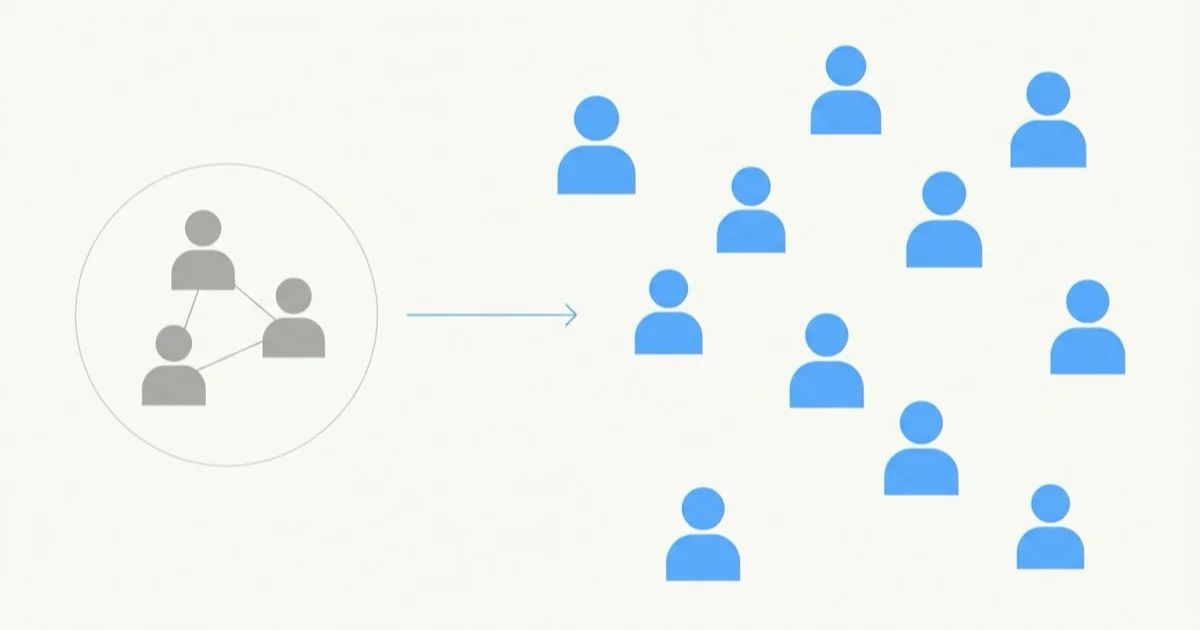
You find useful customer discovery interviewees by defining the experience you need to understand, then choosing a place where people with that experience can be reached.
Your network can help. So can a professional association, an industry event or a community that permits research invitations. The job is to find relevant people who agree to talk. A list of names alone won’t get you there.
Before you open another directory, write down what you need the next conversation to teach you.
Write a six-line target-person brief
“People at SaaS companies” leaves too much for someone else to figure out. Give yourself a profile you can screen against:
- Decision: What will these conversations help you decide?
- Activity: What work must the person have done?
- Time window: How recently must they have done it for the experience to be useful?
- Context: Which conditions matter, such as team size, workflow or type of customer?
- Role: Do you need the person doing the work, approving a change, or both in separate conversations?
- Recruitment route: Where could you reach them, and what permission would you need?
For an annual process, “recently” might mean the last cycle. For a daily task, you may need a much shorter window.
Keep the criteria tied to the question. Don’t require someone to use a particular tool, have a budget or dislike their current process unless that’s necessary for this round. You could otherwise screen out the person who would show you why your assumption is wrong.
Nielsen Norman Group’s screening guidance recommends defining the relevant characteristics before recruiting and asking about past behavior rather than predicted product use.
Choose a route that fits the person
You don’t need to use every channel. Start where you have a credible way to reach people who fit, then check whose experience that route leaves out.
Ask for introductions to relevant people
Send your target-person brief to someone who might know a suitable participant. Ask them to pass along an invitation so the other person can choose whether to respond.
A warm introduction doesn’t make the interview worthless. It also doesn’t make the participant qualified. Screen for relevant experience and remember that a relationship may affect how comfortable they feel disagreeing with you.
Jason Cohen’s guide to finding potential customers includes using your network for introductions to people who fit your intended audience. That’s a different request from asking friends whether they like your idea.
Work with a community or professional group
Look for discussions about the activity you want to understand. Read the rules on research, promotion and contacting members. Ask an organizer or moderator whether and how you can invite volunteers.
If they permit an invitation, describe the research openly. Don’t disguise recruiting as an innocent question, collect everyone who replies into a prospect list, or send bulk private messages.
Reddit’s spam guidance prohibits unsolicited mass engagement and explains that moderators apply community rules. A genuine research purpose doesn’t give you an exemption.
Public reviews can help you understand vocabulary and possible problems. They don’t establish that the reviewer wants contact, paid for the product personally, or stopped using it. Use them to sharpen your questions rather than harvest identities across sites.
Meet people where the work is discussed
An industry association, trade event or relevant meetup may give you access to practitioners. Check with the organizer before recruiting there.
A speaker’s topic can suggest expertise, but it doesn’t establish that they do the work you’re studying today. Ask. Someone responsible for running the process may be more useful than the most visible person in the room.
If you already have customers, willing current and former users can help you understand their experience. Include nonusers when your decision requires understanding why people haven’t adopted. The UK Government’s participant recruitment guide describes working with relevant organizations and existing users, and checking permission to recruit at venues.
Screen before you book
Keep the screen short enough to answer without completing the interview itself. These are three prompts you can adapt:
“When did you last take part in [activity]?” Ask what their part was. Choose a time window that matches the process.
“What did you use to get it done?” Allow for software, colleagues, manual work or no special tool. Don’t make a purchase the price of admission.
“What responsibility did you have?” Distinguish doing the task from managing it or approving changes. Different roles may answer different research questions.
If someone doesn’t fit, thank them and explain that you’re looking for a different experience in this round. Don’t promise to keep them informed unless you intend to.
A job title is a clue. A short account of relevant work tells you more.
Make an invitation someone can assess
Say who you are, what you’re learning, why their experience seems relevant, and how much time you’re asking for. State any compensation and the format. Make participation optional.
If the conversation is research, keep that promise. Don’t call it “no pitch” and then bring a sales deck. Ask separately before recording, and explain what you intend to do with the recording or notes.
Here’s an adaptable invitation for a hypothetical founder investigating customer handoffs, sent after a permitted introduction:
Hi Sam. Alex passed along my invitation because you manage customer implementations. I’m a founder learning how teams move a signed contract into implementation. Would you be open to a 20-minute video conversation about a recent launch? It’s research, with no sales pitch and no payment for participating. You wouldn’t need to share customer names or confidential material. If it isn’t relevant or you’d rather pass, that’s fine.
Change the details to match what you’ll actually do. Don’t invent an introduction or imply you know someone’s workflow from a title.
A hypothetical recruiting example
Suppose you’re considering a tool for B2B SaaS implementation teams. Your decision is whether missing information at the sales handoff is worth investigating further.
You want people who helped run a customer launch in the last three months. That’s a working criterion for this example, not a universal cutoff. You need to understand their role and current process; they don’t have to report a broken handoff to qualify.
A professional association agrees to share your invitation with its members. Volunteers answer the short screen. You book people with relevant experience and note that they’re all association members.
That leaves a gap. Teams outside the association may work differently. You could seek a permitted introduction to someone in another setting, rather than declare the first group’s answers representative.
Once the calls begin, use the customer discovery interview guide to separate what people report from your interpretation and the next test.
How many interviews should you recruit?
There isn’t a universal number that validates an idea. Plan a manageable round, review what you learn, then decide which question or missing experience needs attention.
Nielsen Norman Group’s discussion of interview sample size explains that the research scope and variation among participants affect how much interviewing is needed. It also distinguishes understanding experiences from measuring how common they are.
Repeated answers are useful, but check whether you’ve repeatedly recruited the same kind of person. Keep the recruitment route, role and relevant context with each set of notes. Neither a fixed percentage per channel nor a room full of strangers guarantees good evidence.
What to do next
Write the six-line brief. Choose one suitable route and check how invitations are permitted there. Screen volunteers before filling your calendar.
Then run the conversations and use the startup validation framework to plan the next test. For more guidance, the free five-day Validation Blueprint email course is available through the signup form on this page.
Related Startup Guides
All articlesIdeation
Problem Validation: Are You Solving a Real Problem?
Problem validation is the step most founders skip. How to tell if you are solving a real, painful problem before you spend months building the wrong product.
Ideation
Customer Discovery Interview Questions That Get Receipts
Four customer discovery interview questions, a worked example, and a simple way to separate reported events from assumptions before choosing your next test.
Ideation
How to Validate Your Startup Idea (Before You Waste Months Building It)
Learn a practical 4-step framework to validate your startup idea before spending months building it. Avoid the common traps that lead to early failure.

Farzad Khosravi
No BS Startup Coach · 300+ Founders Coached
I help early-stage founders launch, grow, and lead with clarity. I cut through the noise to the few tactics that actually change your numbers. I've coached 300+ founders across validation, growth, leadership, and fundraising.