
The Primal Trap: The threat is not bad strategy.
It’s your nervous system.
Ancient survival wiring is still running modern boardrooms. The Primal Trap shows high-performing leaders how to recognize, regulate, and disarm the “Ape Brain” before it sabotages decisions, culture, and growth.
Free first chapter from The Primal Trap — instant PDF, no payment.
- Written for founders, executives, and operators leading under sustained pressure.
- Leave with a six-step interruption sequence to run before your next high-stakes decision.
- About 25 minutes to read. Unsubscribe anytime.
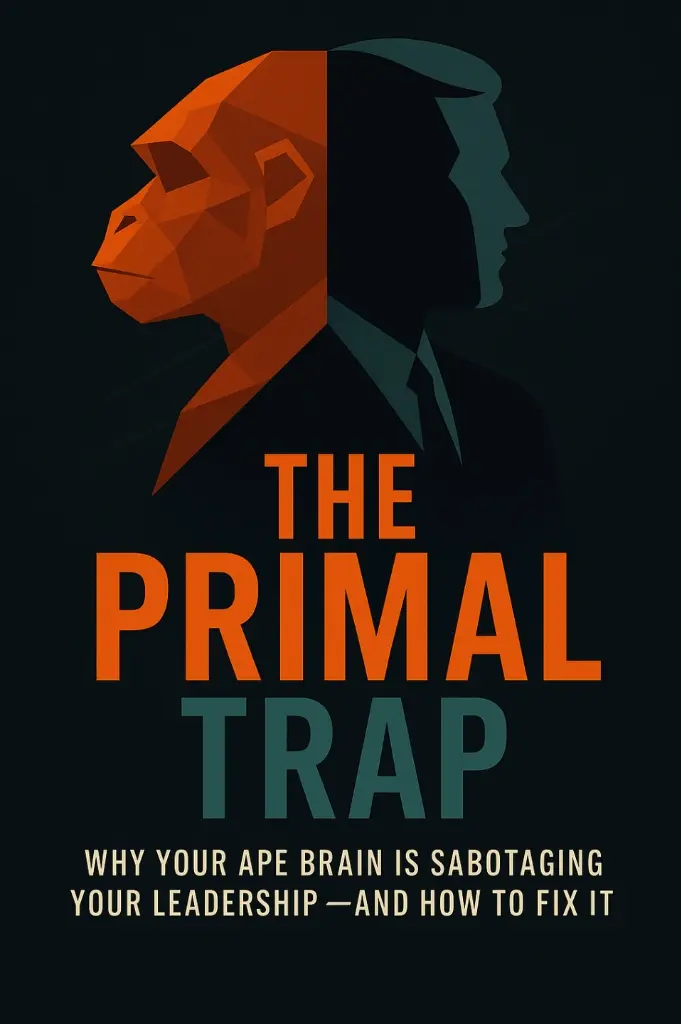
What Is The Primal Trap?
The Primal Trap is the moment your nervous system hijacks your leadership. When pressure rises—a board challenge, a key hire threatening to leave, a quarter slipping sideways—your brain does not distinguish between a competitive threat and a physical one. It activates the same fight-or-flight machinery that kept your ancestors alive on the savanna.
In neurological terms, the amygdala fires before the prefrontal cortex can intervene. Cortisol floods the body. Heart rate climbs. Peripheral vision narrows. The executive functions you depend on for judgment—nuance, empathy, long-term planning—go offline. What remains is a fast, blunt survival system optimized for escaping predators, not running companies.
The result is a leader who feels certain and decisive in the moment but is actually operating from a threat response. Decisions made in this state tend to be rigid, short-term, and self-protective—exactly the opposite of what the situation requires.
Your Ape Brain is Hijacking Your Leadership
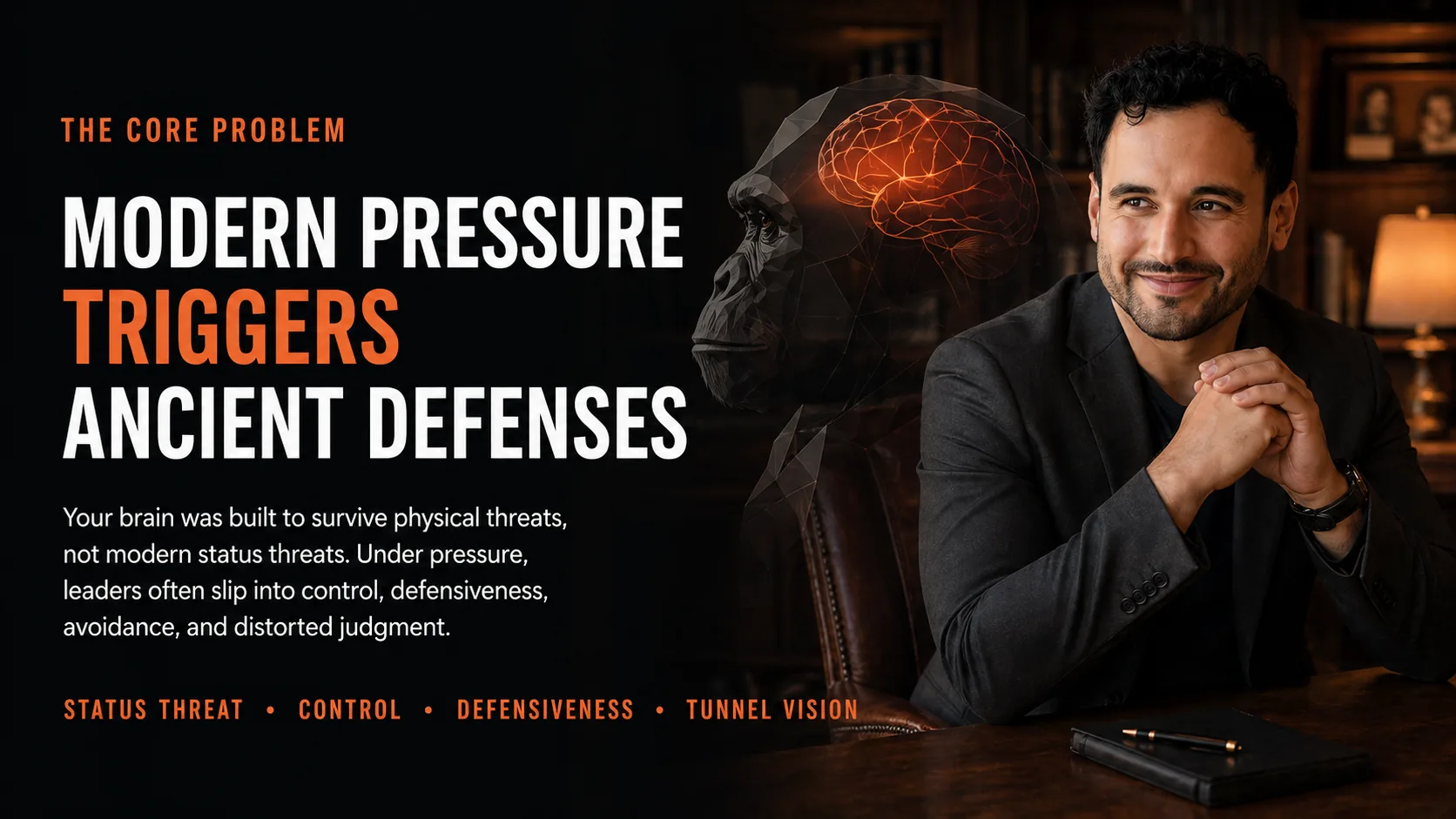
Every high-performing leader carries a hidden vulnerability: ancient biological wiring operating in modern boardrooms. Under pressure—real or perceived—this ancient wiring activates and consumes leaders with anxiety.
It reads status threats as physical danger, uncertainty as a threat to survival, and conflict as something to dominate or escape. The result is fear dressed up as confidence, aggression disguised as decisiveness, and withdrawal masquerading as strategic thinking.
This is how smart leaders end up making disastrous decisions. It is how trust erodes, culture turns political, and organizations drift toward failure without fully understanding why.
Fear Dressed as Confidence
A founder learns a competitor just closed a large funding round. Instead of reassessing strategy, the nervous system fires and the founder doubles down on a failing product line, projecting certainty to the team while privately panicking. The decision feels bold. It is actually self-protective avoidance of uncertainty.
Aggression as Decisiveness
A CEO receives pushback from a VP during a strategy review. The amygdala reads disagreement as a status threat. The CEO shuts the conversation down with authority, overrides the objection, and the room goes quiet. The team learns that dissent is unsafe. Innovation quietly dies.
Withdrawal as Strategy
A founder faces a difficult conversation with a co-founder about equity or role changes. Instead of addressing it, the nervous system triggers a freeze response. The founder delays, avoids, and reframes inaction as “waiting for the right time.” Weeks pass. Resentment compounds. The relationship fractures.
How Survival Instincts Hijack Leadership
Under pressure, leaders move through a predictable pattern: trigger, threat, reaction, and consequence. Once you can see the pattern, you can interrupt it.
The goal is not to eliminate pressure. The goal is to notice when the nervous system has taken over before it turns urgency into control, defensiveness, avoidance, or culture damage.
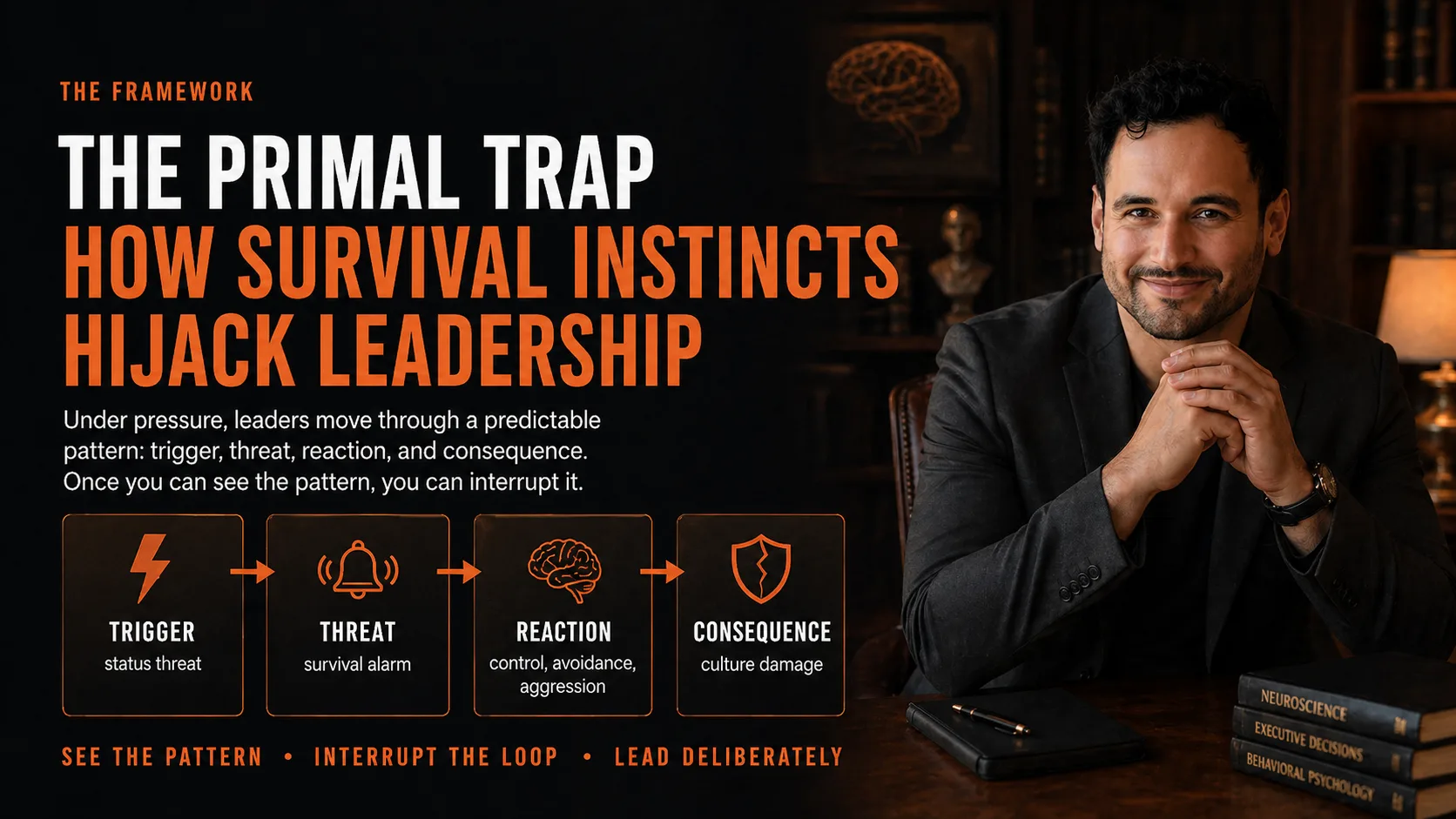
Status Threat
A meeting, conflict, board question, or missed target hits the leader as personal danger.
Survival Alarm
The body starts optimizing for protection instead of clear judgment and long-term trust.
Control or Avoidance
Pressure comes out as over-control, withdrawal, aggression, defensiveness, or tunnel vision.
Culture Damage
Trust erodes, decision quality drops, and the team learns to protect itself instead of the mission.
How To Tell You Are In The Primal Trap
The trap is hard to see from the inside because the nervous system rewrites the situation as it activates. The threat feels real. The reaction feels rational. The damage is invisible until much later. Most leaders only catch it in retrospect—after the meeting, the all-hands, the email they should not have sent. These are the most common signals that your decisions are being shaped by survival biology rather than judgment.
Tunnel Vision On A Single Threat
One issue—a difficult investor, a slipping number, a competitor announcement—occupies most of your working memory. Other strategically important problems are invisible until pressure subsides. This is your peripheral cognition narrowing on the perceived predator.
Urgency That Resists Examination
You feel an intense need to act now. Slowing the decision feels dangerous. When a teammate suggests waiting twenty-four hours, you experience it as obstruction rather than helpful friction. Real strategic urgency rarely punishes a one-day pause. Survival urgency does.
Rising Certainty With Falling Curiosity
Your confidence in a single interpretation climbs while your willingness to consider alternatives drops. You stop asking questions and start defending positions. In a regulated state, certainty and curiosity tend to move together. When they split, the nervous system is in charge.
Body Signals You Are Overriding
Tight chest, shallow breathing, clenched jaw, restless legs, racing thoughts before sleep. Most leaders notice these and push through them. They are not noise. They are real-time data that the threat response is engaged and your judgment is being filtered through it.
Black-And-White Framing Of People
Colleagues become “with me” or “against me.” A capable VP becomes “not strategic enough.” A supportive board member becomes “not really in our corner.” The amygdala compresses nuance into ally-or-threat categories so the body can act faster.
Replaying The Same Loop At 3 A.M.
The same conversation, email, or scenario keeps cycling at night. The content varies but the underlying pattern—rehearsing protection, rehearsing attack, rehearsing escape—is identical. The nervous system is still scanning for danger long after the office is empty.
A Practical Framework To Disarm The Trap Before A High-Stakes Decision
You cannot eliminate the threat response. It will fire whether you want it to or not. What you can do is build a short, repeatable interruption sequence between trigger and reaction. Run this before any conversation, decision, or response that feels charged—a board call, a difficult one-on-one, a pricing pivot, a hiring decision, an inflammatory message you are about to send. The goal is not calm. The goal is choice.
-
Name The State, Not The Story
Before you analyze the situation, label what is happening in your body. “My chest is tight. My jaw is clenched. I am running hot.” Naming the state moves activity from the limbic system to the prefrontal cortex and reduces amygdala intensity. Do not analyze the trigger yet. The story can wait sixty seconds.
Concrete step: take ninety seconds, eyes off the screen, name three physical sensations out loud or in writing.
-
Reset The Body Before The Decision
A regulated body produces regulated decisions. Use a short physiological reset to lower sympathetic activation: a double-inhale through the nose followed by an extended exhale, repeated four to six times. Or two minutes of slow nasal breathing with a six-second exhale. This is not wellness theater. It measurably shifts heart rate variability and restores access to executive function.
Concrete step: do not enter the meeting, draft, or call until your exhale is longer than your inhale for two full minutes.
-
Surface The Threat You Are Actually Reacting To
Ask, on paper: “What does this situation feel like it is threatening?” Status, control, identity, financial security, belonging. The honest answer is rarely the surface issue. Once the underlying threat is named, you can decide how much of your response should be aimed at the real threat and how much at the visible one. This single question collapses most reactive over-reach.
Concrete step: write one sentence that begins, “Underneath this, what I am protecting is…”
-
Run The Twenty-Four-Hour Test
Before any irreversible action—termination, restructuring, public message, ultimatum—ask whether the same decision will still feel correct twenty-four hours from now. Reactive decisions almost always lose conviction overnight. Strategic decisions almost always keep it. If you cannot wait twenty-four hours, you can usually wait two. The friction itself is the diagnostic.
Concrete step: name one decision in the last quarter you would have unmade if a one-day delay had been forced. Use that as your default delay rule.
-
Recruit One Outside Mind
When you are inside the trap, your own brain is unreliable narration. A trusted co-founder, advisor, coach, or peer can see what you cannot. The rule is not “ask for permission.” The rule is “describe the situation, the action you are about to take, and the threat you suspect is driving it.” Their job is to test the alignment between the three.
Concrete step: pre-designate one person as your “amygdala check” and message them before any emotionally-charged decision.
-
Decide From The Future, Not The Trigger
Ask: “If I were already through this, looking back, what response would I respect?” This single reframe pulls decision-making out of the threat moment and into a longer time horizon where strategy, culture, and reputation actually live. The Ape Brain optimizes for the next ten minutes. The leader has to optimize for the next ten quarters.
Concrete step: write two sentences—what the trigger wants you to do, and what your future self would respect—and choose between them deliberately.
Used together, these six steps usually take under ten minutes. They will not make the pressure go away. They will give you the gap between trigger and reaction that high-stakes leadership requires. The full version of this protocol—including the longer pre-decision audit and the post-event integration practice—is in the book.
The Concepts Behind The Frameworks
None of this is novel science. The Primal Trap synthesizes well-established research from neuroscience, organizational psychology, and stress physiology and translates it into language and steps that founders and operators can actually use under pressure. The references below point to the underlying ideas; they are starting points, not credentials borrowed for authority.
-
Amygdala Hijack & Threat Response
The phrase "amygdala hijack" was popularized by Daniel Goleman to describe how emotional brain regions can override the prefrontal cortex during perceived threat — the mechanism this page calls the Ape Brain.
Reference: Goleman, D. Emotional Intelligence (1995); LeDoux, J. The Emotional Brain.
-
Stress Physiology & Decision-Making
Sustained activation of the human stress response narrows attention, biases toward short-term action, and degrades complex judgment — the same mechanism that makes a regulated nervous system a leadership advantage.
Reference: Sapolsky, R. Why Zebras Don't Get Ulcers.
-
Hot vs. Cold Cognition
Decisions made under emotional load are systematically different from decisions made in a regulated state. The 24-hour test in this framework is a practical application of this well-documented divergence.
Reference: Kahneman, D. Thinking, Fast and Slow.
-
Psychological Safety In Teams
Amy Edmondson's research at Harvard Business School established psychological safety as a measurable predictor of team performance — and the foundational tier in the Business Hierarchy of Needs above.
Reference: Edmondson, A. The Fearless Organization (2018).
Note: The Primal Trap describes leadership and decision-making patterns, not a clinical condition. Nothing on this page is medical advice or a substitute for working with a licensed clinician where appropriate.
Lead Beyond Survival
In The Primal Trap, Farzad Khosravi argues that many leadership failures are not failures of intelligence or strategy. They are our 'Ape Brain' gone wild, controlling us through unexamined, unnamed processes at play in modern organizations.
Drawing on sixteen years of research in neuroscience, psychology, behavioral economics, and operating experience building and scaling companies, Khosravi gives you the tools to do what most leaders never attempt:
Identify Triggers
Learn to identify the primal triggers that hijack critical decisions at the worst possible moment.
Disarm Invisible Forces
See the invisible forces eroding your culture and learn exactly how to disarm them before they cost you talent.
Conscious Awareness
Gain practical, science-backed frameworks for building the capacity to lead with awareness under genuine pressure.
The Business Hierarchy of Needs™
Optimization happens from the bottom up.
Predictable Growth
Scalable success is a mathematical byproduct of reliable systems and data-driven decision loops that remove the founder as the primary bottleneck.
Efficiency
Eliminate high-friction activities. Use operational leverage and technical compounding to amplify team output without increasing headcount.
Sustainability
Protect the leader's biological capacity. Build a business that preserves mental energy, prevents burnout, and ensures long-term stability.
Psychological Safety
The fundamental neurological requirement for innovation. When teams feel safe to fail, they solve complex problems without fear-based loops.

The Anti-Guru.
- 3× Founder & Fractional COOOperator background, not a credentialed outsider.
- ICF-Trained Executive CoachFormal coaching foundation behind the frameworks.
- 500+ Founders & Leaders CoachedPatterns drawn from sample size, not anecdote.
- 150+ Five-Star GrowthMentor ReviewsIndependently verifiable client feedback.
- Humoniq (YC S25) — $8.5M SeedFractional COO during fundraise and scale.
- Nylas — Built CS Through $140M Series COrg-building experience under sustained pressure.
Farzad Khosravi is a three-time founder, fractional COO, owner of the snack brand Hot Date Kitchen, and ICF-trained executive coach working at the intersection of leadership psychology, company building, and AI systems.
He has served as a fractional COO to high-growth companies including Humoniq (YC S25), where he helped secure an $8.5 million seed round, and Traversaal, reaching $500,000 in first-year revenue. Earlier, he built the Customer Success organization at Nylas from zero through their $140 million Series C expansion.
With over 500 founders coached and 150+ five-star reviews on GrowthMentor, Farzad's work is shaped by a 16-year effort to understand why smart leaders make bad decisions. Born in Iran and raised in Kentucky, he helps leaders finally see the forces that have been shaping them all along—and choose, deliberately, what leads next.
The Primal Trap is written by an operator who has run the loop it describes — under fundraise pressure, founder conflict, missed quarters, and live customer escalations — not by a clinician or a credential-only coach. The frameworks are field-tested with the same kind of leaders the book is for.
Questions About The Primal Trap
What is The Primal Trap?
The Primal Trap is the moment under pressure when a leader's nervous system overrides judgment. Survival biology — the same fight-or-flight machinery that kept ancestors alive on the savanna — fires before the prefrontal cortex can intervene, so the leader makes rigid, short-term, self-protective decisions while feeling certain and decisive.
Who is The Primal Trap for?
Founders, executives, and operators leading under sustained pressure — fundraises, board challenges, missed quarters, founder conflict, escalations. It is written for high-performing leaders who want to recognize and interrupt threat-driven decisions before they damage culture, trust, or strategy.
Is this about neuroscience or leadership?
Both. The Primal Trap synthesizes well-established neuroscience and stress physiology — amygdala hijack, hot vs. cold cognition, sympathetic activation — and translates it into language and steps founders can actually use. It is grounded in the science but written as a practical leadership manual, not a textbook.
What is the Ape Brain in leadership?
Ape Brain is the shorthand this book uses for the threat-detection wiring — the amygdala-driven survival system — that activates when a leader perceives status, identity, or financial danger. It reads disagreement as attack, uncertainty as predator, and conflict as something to dominate or escape, and it does this faster than conscious thought.
What do I get in the free chapter?
An instant PDF of the first chapter of The Primal Trap delivered by email — no payment, no credit card. It introduces the Ape Brain mechanism, the trigger-threat-reaction-consequence loop, and the six-step interruption sequence to run before any high-stakes decision. About 25 minutes to read.
How does this connect to founder decision-making?
Most founder mistakes — premature firings, reactive pivots, defensive board responses, scorched-earth emails — are not failures of intelligence. They are decisions made from a hijacked nervous system. The book gives founders a way to spot the hijack, regulate the body, and decide from strategy rather than from the trigger.
When the same hijack keeps repeating
For a closer look at the in-the-moment mechanics — the four-second interrupt, affect labeling, and what to do when your prefrontal cortex goes offline mid-meeting — read Amygdala Hijack in Leadership: Why Smart Founders React Badly Under Pressure. It is the practical companion to The Primal Trap and covers the five most common founder hijack triggers.