
Founder Delegation: How to Let Go Without Losing Control

3x founder · Coach to 300+ founders

How to Delegate as a Founder Without Losing Control
A founder told me last month: “I can’t find people who care like I do.”
He had 12 people on payroll. He was reviewing every customer email. He was rewriting headlines his marketing hire had already approved. He was tired, his team was demoralized, and revenue was flat.
His problem wasn’t his team. It was that he’d never written down what “good” looked like, so nobody could meet a standard they couldn’t see.
This is the most common founder failure mode I see. You can fix it in a week if you’re honest about which part is yours.
Why can’t founders delegate?
Because handing off ownership feels like exposure, and your survival wiring reads exposure as threat. The story you tell yourself: “Nobody else can do it as well as I can.”
If you’ve spent five years building this thing from zero, watching someone else touch it triggers that wiring every time. You’d rather do it badly yourself than watch someone else do it badly on your behalf.
That’s not a leadership problem. That’s biology. And it shows up in three concrete ways.
You hold on to tasks others could run because you don’t trust the handoff. You skip writing the rules down because writing them down means committing to them. You take work back two weeks later because the result wasn’t exactly what you would have done.
None of these are tactical. They’re identity. You scale a company by replacing yourself in the places you no longer add unique value. You don’t scale by being the busiest person in the room.
If you can’t name three places where the company would break without you, you have already built a single point of failure into your own company without noticing. Delegation is how you dismantle it. The survival wiring that fires when you try to hand off a task is the same amygdala hijack that fires when an investor questions your retention. Same threat detector. Different threat. Not sure how deep the dependency runs? The founder bottleneck assessment scores it across decisions, sales, and knowledge in 3 minutes.
The delegation spiral
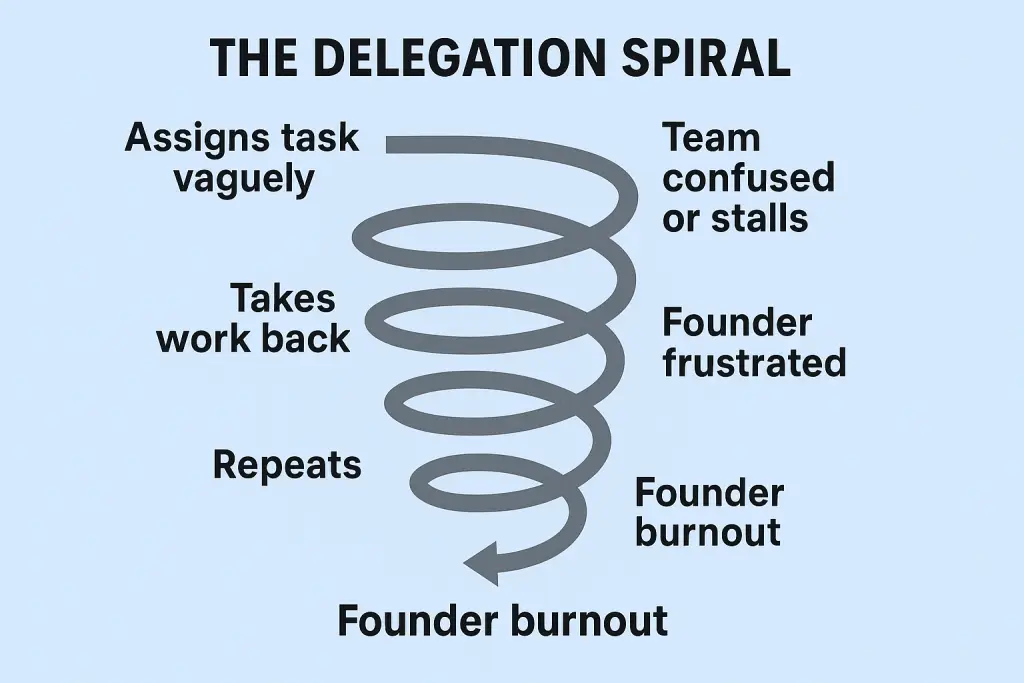
Most founders delegate the same way every time.
The intention starts good. “I’ll do this one last thing, then I’ll hand it off.” The calendar fills. Pressure builds. Friday afternoon, you drop the task on someone’s lap with no context, no standard, no example of done. They make a reasonable guess. It comes back not-quite-right. You quietly take it back. The cycle repeats.
This isn’t a delegation failure. It’s a system failure. You handed off work without a system. The fix isn’t trying harder. It’s building the system once.
What a real system needs:
- A one-sentence definition of what “done” looks like.
- One example of the floor (what you would not ship if you saw it).
- A decision rule for when to escalate to you and when to ship without asking.
- A feedback loop that doesn’t depend on you re-reading every output.
If the handoff is missing any of those four, the work comes back. Every time.
What it costs you to keep doing it all
You become the bottleneck on your own company. Tasks queue behind your inbox. Approvals stall. Small problems grow because nobody else feels authorized to act.
Meanwhile your strategic work slips. You spent your morning reviewing copy your marketing hire already wrote. You spent your afternoon answering support tickets your CS person could have closed. You go to bed feeling busy. You wake up to find revenue didn’t move.
The math is simple, and somebody already ran it. In 2015 Gallup surveyed 143 Inc. 500 CEOs. The ones who scored high on delegation posted an average three-year growth rate of 1,751%, which is 112 percentage points above the CEOs who scored low. They booked $8 million in 2013 revenue against $6 million, and added 21 jobs in three years against 17.
Read that carefully, because most people who quote it overclaim. It is a correlation across companies that had already made the Inc. 500, so it cannot tell you delegation caused the growth. What it does tell you is that the fastest-growing private companies in America are not the ones run by a founder who reviews every customer email.
The leverage you wanted is on the other side of letting go. The bottleneck you can’t see is you.
This piece is the tactical companion to my Leadership OS pillar, which lays out the three layers (Decisions, Defaults, Delegation) you can audit and rewrite deliberately instead of running them by accident.
How do you delegate without losing control?
Hand off outcomes with a written floor, start with low-risk work, and make your rules visible to the team.
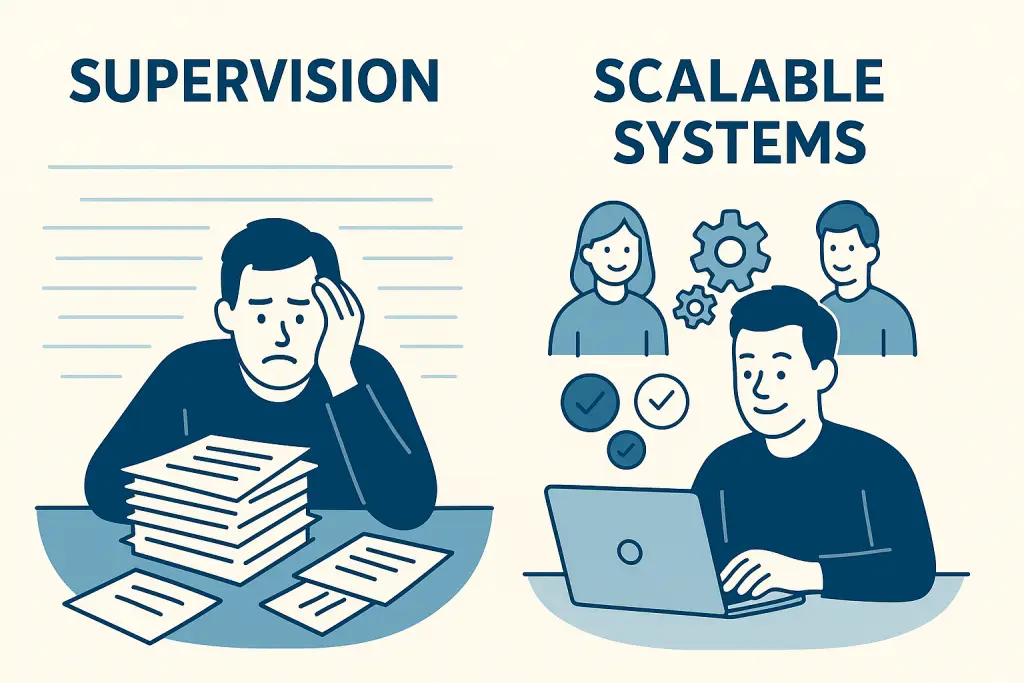
Andy Grove built High Output Management on one idea: your output as a manager is the output of your whole organization, not the work you personally produce. Measured that way, the highest-leverage activity a founder has is delegation. And delegation is not handing out tasks and hoping. It is investing in someone until they can own the decision itself.
Five moves. I use these with every coaching client. They work.
1. Hand off outcomes, not instructions
The mistake: you tell your designer how to do the work. “Make the button blue, then move it to the left, then add a tooltip.”
The fix: tell them the outcome. “Sign-up conversion is at 3.2%. Get it to 4% in 30 days. Here are the three sign-up flow examples I think we should benchmark against.”
When you describe the goal instead of the steps, three things happen. The person owns the result, not the task. They get faster because they’re not waiting for your next instruction. They get better at the work because they’re forced to think, not execute.
2. Write the floor, not the ceiling
The mistake: founders define “great” and expect the team to hit it. Then they’re disappointed when the team produces “okay.”
The fix: define the floor. The thing you would not ship if you saw it. Write it down. Hand it over with the work.
For copy, my floor is one sentence: “If a smart 9th-grader can’t read it, rewrite it.” For decks, my floor is two: “No slide has more than three bullets. No bullet runs more than one line.”
The floor is concrete. The ceiling is vibes. Hand off floors.
3. Use the Keep / Let Go / Coach filter
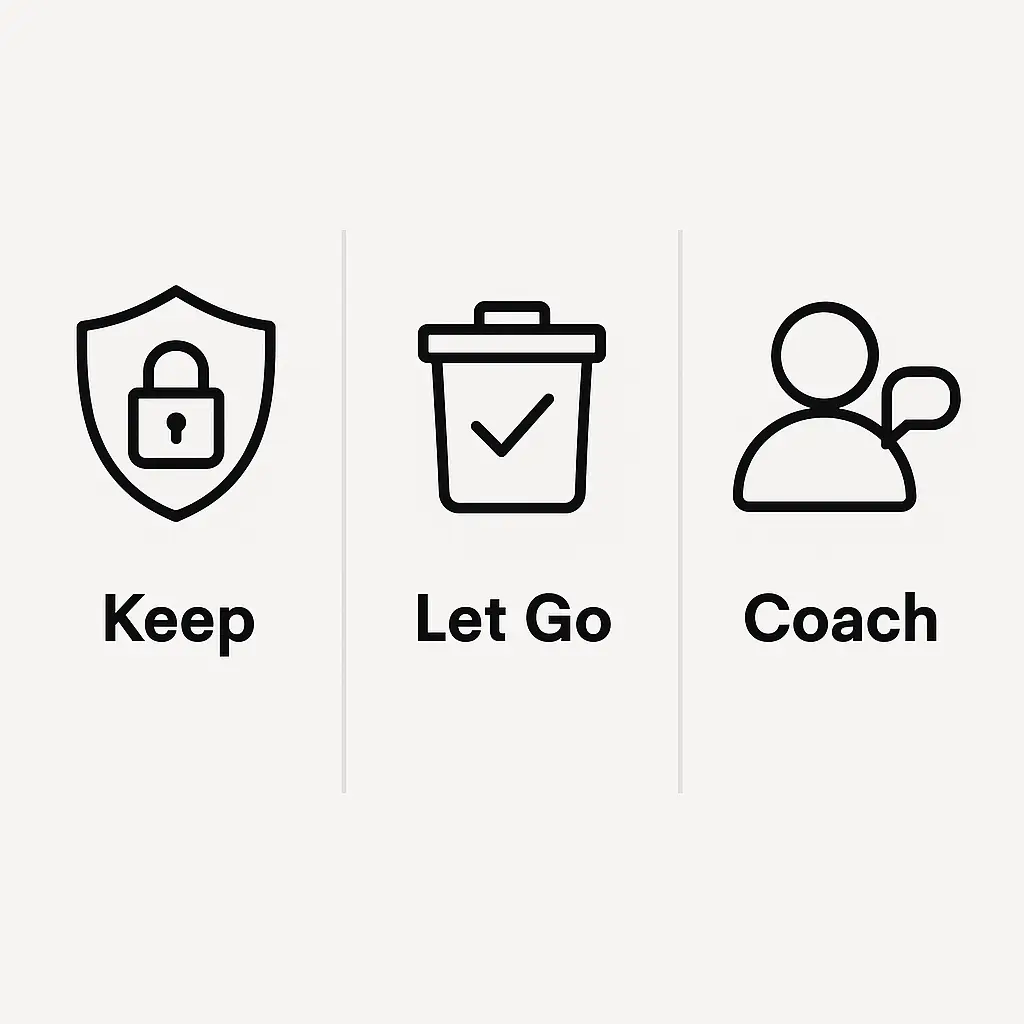
Take every task you’re currently doing. Put each one in one of three buckets.
Keep the work that requires your unique judgment, your relationships, or your long-term context. Strategy calls with key customers. Hiring decisions for senior roles. The first draft of a fundraising deck.
Let go of anything repeatable, low-leverage, or below your hourly rate. Calendar management. Receipt logging. The third round of edits on copy your team already approved.
Coach the middle. Tasks someone else can own after one or two strong handoffs. Customer renewal calls. Performance reviews for direct reports. The kind of work where you’re not adding much after handoff #2.
Founders trap themselves in the coach bucket. Too advanced to fully delegate, too repetitive to keep doing. That gray area is where 80% of your time leaks out. Coach the work, then let go.
4. Start with low-risk, high-leverage tasks
The mistake: you try to delegate the most important thing first. Investor updates. Product strategy. The high-stakes customer call. Then it goes badly, your trust dies, and you swear off delegation for six months.
The fix: start with low-risk work that still creates time. Inbox triage. SOP documentation. Internal status updates. Customer follow-ups on closed tickets.
These don’t change the numbers on their own. But they free up four to six hours a week, and they give your team reps at meeting your standards. When the small handoffs land cleanly, the bigger ones become possible.
I’ve never seen a founder successfully delegate strategy before they could delegate scheduling.
5. Tell two people the rule exists
A rule kept in your head is a vibe, not a rule. The team can’t see it, so they can’t meet it.
When you decide “we don’t take enterprise calls that require custom features,” tell two people that’s the rule. Your co-founder. Your COO. Your spouse if you have to. Now you have one person who’ll hold you to it and one person who’ll ask why you broke it.
Most founder rules die because the founder is the only one who knows the rule exists. The team learns to read your mood instead of your principles. Make the principles visible. The team will stop guessing.
The control reflex behind “nobody cares like I do”
Here’s the uncomfortable bit. Every founder I’ve worked with who refuses to delegate has the same underlying belief: if I let go, this thing dies.
That belief is wrong. It’s also old. It’s the same survival wiring that made you start the company in the first place, now turning on you. The thing that got you from zero to one is now the thing keeping you from one to ten.
I wrote about this biology in The Primal Trap. The 30-second version: under pressure, your nervous system fires before your judgment does. You take back work, you micromanage, you rewrite the email someone already sent. After the fact, you tell yourself a story about why it was necessary.
It wasn’t necessary. It was reactive. And it costs you more than the bad handoff ever would have.
Where to start this week
Pick one task you’re currently doing that’s below your pay grade. Inbox triage works. SOP docs work. Customer follow-ups work.
Write the floor in one sentence. Pick the person who’ll own it. Hand it off with the floor and one example. Tell them: ship without asking unless you hit a blocker.
Run it for 30 days. Track where it failed. The failures are the seed of your handoff template.
That’s the entire system. 90 minutes of writing, four weeks of running it, and you’ve replaced yourself in one place. Do that three times this quarter and you’ve taken 12 hours back. Use them on the work nobody else can do.
If the reason you can’t hand anything off is that you’re running on empty, read the founder burnout playbook first. Delegation built on exhaustion collapses.
If you want help building the full Leadership OS that runs underneath this, see how the coaching works. If you’re earlier and not ready for coaching, the No BS Startup Guide walks the same material at your pace.
Control didn’t get you here. Clarity will get you out.
Related Startup Guides
All articlesLead
Your Company Can't Move Without You. That's a Single Point of Failure.
If your startup slows down every time you step away, that is not commitment. It is a single point of failure you built. Here is how founders spot it and fix it.
Lead
The Three Great Success Myths
The three leadership lies founders tell themselves about fixing problems, giving feedback, and hiring experience, plus the science-backed alternatives.
Grow
Startup Coach vs Accelerator vs Advisor: Which One You Need
Startup coach vs accelerator vs advisor: what each costs, which stage each fits, and how each one fails. By a coach who was fractional COO inside a YC startup.

Farzad Khosravi
No BS Startup Coach · 300+ Founders Coached
I help early-stage founders launch, grow, and lead with clarity. I cut through the noise to the few tactics that actually change your numbers. I've coached 300+ founders across validation, growth, leadership, and fundraising.